


*Updated 8-29-17*

How to determine compression requirements for corrugated boxes? It's important to figure out this information to make sure your boxes can withstand certain pressures during shipping and receiving. If the compression strength and distribution environment is known, the effective stacking strength of any given RSC can be reasonably estimated. A standard can be estimated if the distribution environment, container dimensions, and flute profile are known. Once a compression requirement is decided, the ECT requirement can be determined.
[message_box]Compression Requirement: The minimum dynamic (in-lab) compression strength required to provide safe stacking performance throughout that container's expected life cycle (given time, environmental/distribution conditions).
In order to integrate the calculated compression requirement into manufacturing specifications, customers and box manufacturers must concur on the nature of its use: long term average, average of a five (or more) box sample or absolute individual box minimum value.
Typical compression requirement determination only considers the static (warehouse) portion of the distribution environment. In some instances, the compression loading on the bottom box in a stack or unit may be greatest in the dynamic (transportation) portion of the environment. Containers in motor freight transport routinely see dynamic loading forces ranging from less than .5 re greater than 1.5 g's. It is very important to consider rep loads, shock and vibration inputs in transportation.
How to Determine your Compression Requirement
Example: Extreme Static Loading
- Boxes stacked floor to ceiling in a freight container, 180-day stack time, 80 percent RH, interlock stack pattern, on container floor
- Box size (outside dimensions): 1.5 ft.(L) x .75 ft.(W) x 1 ft. (D) (0.5 m(L) x 0.25 m(W) x 0.33 m(D)
- Freight container height: 10 ft. (3.05 m). Stack will be 9 ft. (3 m)
- Box gross weight: 26.4lbs. (12 kg)
| Determine maximum number of boxes above bottom box: | ( Gross height / Box depth ) - 1: (9ft. / 1ft.) -1 = 8 boxes above bottom box |
| Determine load on bottom box | Number of boxes times weight: 8 x 26.4lbs. (12 kg) = 211 lbs. (96 kg) |
| Determine environmental factor by multiplying together all factors that apply: | 180 days = 0.5 (50 percent loss) x 80 percent RH = 0.68 (32 percent loss) x interlocked stack: = 0.5 (50 petcent loss) = [0.5] [0.68] [0.5] = 0.17 |
| Determine environmental multiplier: | 1 divided by the Environmenta Factor: ( 1/ .017 ) = 5.88 |
| Determine box compression requirement: | Load x Environmental Multiplier: 211lbs. (96 kg) x 5.88 = 1,241 Ibs. (564 kg) |
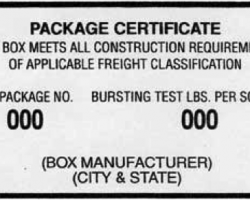
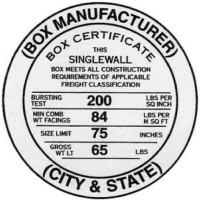
Manufacturer's Seals for Burst Test:
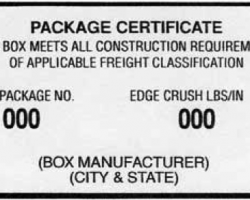
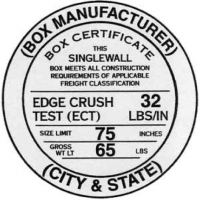
Manufacturer's Seals for Edge Crush Test:
See also: